Category Archives: india
Flying Visit
After years of flying various airlines in the US and watching them get shoddy and shoddier in service, I always find it a pleasure to fly the airlines in the East. The best example of service continues to be Singapore Airlines. In one word, fabulous. Others that make a mark with their customer care include Thai, Malaysian, Air Nippon, Air China and of course Emirates. In India, I have seen this service difference (compared to US airlines) in both Jet and Kingfisher; today, they are the most prevalent full-service airlines serving the country. You can’t really go wrong with them (except perhaps on pricing when flying to Delhi).

Taking off
In addition to these, one upstart airline that I have had the pleasure of flying to domestic locations recently is actually a low-cost, no-frills carrier. The one I speak of is called IndiGo Airlines. In keeping with the name, all the flight attendants dress up in a smart indigo cap, a corsage/scarf thingy and a chic gray dress (more about this later). The airline itself reminds me a lot of Southwest Airlines – one of the big success stories of the West. It may be low in cost, but it is high on service, efficiency and consistency (to keep the costs down, for example, they standardize on one type of aircraft).
They particularly excel on being on time. This has to be the most on-time focused airline I have flown. Clearly, it is the top objective for them. And, I have noticed that the staff at all levels – check-in, ground and in-flight take extra care to keep or beat the published schedule. It is almost as if this is a mantra that has been brain-washed into them. Come to think of it, it probably has. They pride themselves in what they call “Indigo Standard Time”, and pat themselves on the back and in their in-flight announcements when the flight touches down on or before their schedule. It’s a great way to communicate and market their prowess in this area and I salute them for it.
[Sidebar: Often I have seen where executive management (of any business) creates key objectives for the staff to execute. Once they have been successfully accomplished, management forgets to make a big enough deal of them – internally or externally. Big mistake. Success feeds on itself and communication is essential to ensure that everyone knows how successful you have been. It’s funny and ironic how quickly and broadly failures are communicated though; what, they want them to multiply? ]
The staff of IndiGo – like most other airlines in India – is very (I mean, very) young. They appear to be trained well and they work hard. An interesting observation about their dress and style – like I said, they have smart uniforms and all the slim (without exception) flight attendants make those uniforms look good. They also appear to have very strict standards on makeup – everyone wears the same shade (made by the same brand, I am sure) of bright pink lipstick, and their eye makeup is applied just so. The eyes are exaggerated through what I would call ’70-80s style eye makeup – a bit retro and dramatic with thick liner and a lift at the corner like an old-times heroine (Hollywood/Bollywood – take your pick; Audrey Hepburn or Sadhana). Imagine this carefully crafted look being so very consistent, from person to person in the cabin. I didn’t notice any male flight attendants on the IndiGo flights I was on, but in any case, I will assume that these standards are only for the females on the team. :-)*
But that’s not all. The next thing I noticed was one gal who had a pixie-like blunt haircut. It looked kinda cute and she did too. I didn’t think too much of it. Until a bit later, I saw her again. Except this was a different flight attendant. I literally thought there may be twins serving on the same flight. And then I looked closer. They were the same height (and of course the same build), but twins they were not!
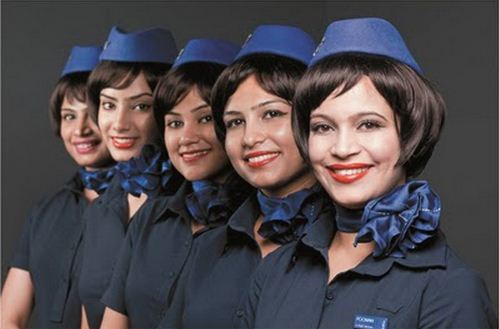
Would I kid you? (Photo courtesy of bangaloreaviation.com)
No two people’s hair can look so much alike, I don’t care what standards they follow. Then, I realized what was going on. These girls were wearing wigs! Wow! If that doesn’t take the cake, I don’t know what does. I’m not exactly sure what the reasoning behind this is – whether it was someone’s great idea of making hair part of the uniform, or whether it was for reasons generally related to grooming, but I have never seen anything like it!
Just to be sure, on the return flight, I looked out for the pixies. Sure enough there were two of them. Strangely, it was not all of them. What gives?
It made me curious enough to check it out…with google, of course. So, it wasn’t my imagination after all. Check out this September 2010 article when their new uniforms were announced. It’s aptly titled: “She’s a hair hostess!”
Seriously, my kudos to IndiGo Airlines for its focus on efficiency, as well as for its business strategy and customer service. I believe it is shaping up to be a serious contender in the local aviation market. But, man, the wigs gotta go!

IndiGo Cabin Crew Recruitment (Courtesy: GoIndiGo.com)
*P.S. I checked out their website later and saw their recruiting pitch for new cabin crew – they’re promoting the chance to be “Miss IndiGo” to their prospective recruits. I would guess that leaves the guys out as far as cabin crew goes.
English Spoken Here
I have been under a total misconception of the facts when it comes to English speaking Indians. Based on the British colonial legacy of this country, I have always been under the impression that the English speaking skills in this country run broad and deep, or at least broader and deeper than would have been otherwise. I have also believed that this has contributed to the growth of trade over the past few decades (I still believe this). Think of the $70 billion IT industry that exists in India today. Surely one of the key growth factors had to do with language and communication? This, despite the complaints I hear from American friends about the trouble they have understanding (and vice versa, I’m sure) their customer support representative for American Express (substitute this for pretty much anything else) – based in Bangalore.
Having gone to a “convent” school myself, I learned to speak some close form of the Queen’s English; this has become slightly tarnished during my years of living in the US, despite my best efforts. 😉 As far as written English goes, I believe America actually improved it. Now, I use “color” instead of “colour” removing an unnecessary letter in the process, and lightening my load, so to speak.
In any case, as many other immigrants from India have experienced, people in the US are surprised when I say I am from India and it’s all based on this: “My, but your English is so good!” And it takes me very little time to reply – “That’s because the British left a legacy behind in India and I was one of millions that grew up with it”.
So, it really surprised me to read some new statistics on the English language. These were based on an English proficiency study that was conducted by an educational organization called Education First who ranked forty countries according to their English language skills. Here is what I learned in a nutshell:
- The proficiency level for India is defined as “Very Low” – this at least is understandable given its large population and the relatively low percentage of fluent English speakers. But, here’s what really surprised me:
- India ranks lower than China (also rated as “very low”) in English proficiency!
- Due to the inconsistent meaning of “proficiency”, the British council stated that there was a very wide range of between 50 and 350 million English-proficient people in India in 2010.
- What is even more surprising is that in the same year, China had between 250-350 million English “learners”.
- According to this organization, China is poised to surpass India in the number of English speakers in the coming years, if it has not done so already!
Aside from being surprised by these numbers, I was fascinated by how quickly China has caught up. I believe that is what happens when a nation has a vision and a grand plan.
The other surprises for me were that Malaysia was the only Asian country rated as having High Proficiency (it also was the top ranked Asian country) and that both Japan and Korea (rated Moderate) surpassed India. That really surprised me probably because I was thinking about Japanese and Korean immigrants in the U.S. But, apparently, back in their home countries, the government has placed a strong emphasis on English study. Why? To benefit from the global economy that increasingly relies on English as the language of trade. Take a look:

Another aspect that I have noticed in India is that the English that is taught and learned in school today has less of a feel of the Queen’s English, and more of a feel of something that is uniquely Indian. The accent certainly is less British and more Indian. I would guess that this is just a natural transition, as the generational gap increases since the year that British left India. Would it be unpatriotic of me to say, I prefer the language my generation was taught? So be it, but I do.
What I still can’t get over is the map above! I believe that I was (along with others?) just a bit too smug in my assumptions. Time to correct them, no?

 The Yin and Yang of Life Anywhere