Category Archives: india
My Hero (yet again): Bill Gates
He’s my hero yet again, an unlikely one at that! No, not because he was named to one of those “Top” lists once more – he’s #5 on Forbes’ latest list, Top 100 Most Powerful People in the World. That’s so been there, done that for Bill Gates.
It’s for this:
“The metric of success is lives saved, kids who aren’t crippled,” says Gates. “Which is slightly different than units sold, profits achieved. But it’s all very measurable, and you can set ambitious goals and see how you do.”

Forbes has a wonderful article (from which this quote was taken) that I would strongly encourage you to read. It’s called:
With Vaccines, Bill Gates Changes The World Again
Here is the Cliff Notes version. It aims to show you why he (& Melinda Gates) should be your heroes too.
Did you know?
- When Bill and Melinda first started their initiatives in public health, they went the way of birth control thinking that with each unborn child (in developing nations) you saved a child from hunger, poverty and illness.
- He had his epiphany later when he recognized that when mortality rates fall, so do birth rates, leading to the a stable population. As he said about his realization, “Most people don’t choose to have eight children because they want to have big families, it turns out, but because they know that many of their children will die“.
- That was when he did a complete turnaround and decided that instead of preventing births, he would give his billions towards saving lives, specifically of children that were already born and lived in environments of poverty and poor health.
- With this, he set out to fight the war with the vaccine – because vaccines – not doctors, not hospitals or anything else – could scale to the level he needed and fight the war against debilitating and fatal diseases. Melinda Gates echoes that thought: “Where’s the place you can have the biggest impact with the money? Where can you save the very most lives with those resources?”
- His total Foundation endowment is now $36 billion, with $25 billion given away for his various causes.
- You cannot do without the money, but money alone does not do the work. You have to coerce, motivate, negotiate, create market demand and create a sustainable business model so that governments can get to work and pharmaceutical companies can get to work – in developing and distributing vaccines to all the people that need them. Who better to take this on than Bill Gates?
- The solution he helped create for driving vaccines to those who need it the most in the world was to create the Global Alliance for Vaccinations and Immunizations (GAVI) by working with UNICEF, the World Bank, UN, various pharmas and aid groups. He provided it a $2.5 billion pledge.
- With this they created a sustainable economic environment that will ensure that their money is in fact reaching millions of children around the globe in the form of whatever is needed for a healthy, productive life.
- This is just part of the magic of what Bill and Melinda Gates are doing with their billions. You can see what some of their other grants are here.
I end with this paragraph from the awesome Forbes article written by Forbes writer Matthew Herper; I sincerely hope that you will read it in it’s entirety and get inspired by this amazing man –
It’s heady, historic stuff: America’s richest man—he’d be the world’s richest had he not already given away so much money—still in his prime (he just turned 56), with the reputation, resources and determination to stamp out infectious disease. “I’d be deeply disappointed,” says Gates, if in the next 25 years he can’t lower the death toll by 80%. Otherwise, “we’re just not doing our job very well.”
Now, can someone please enlighten me – is there truly any other individual alive today who is doing so much for the people of this world?
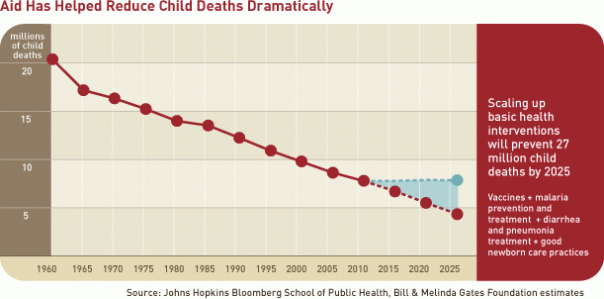
One chart presented by Bill Gates to world leaders at the G20 Summit
Read more about the progress being made by the Bill and Melinda Gates Foundation here.
:
Photo and Image Credits:
Bill and Melinda Gates By World Economic Forum from Cologny, Switzerland [CC-BY-SA-2.0 (www.creativecommons.org/licenses/by-sa/2.0)], via Wikimedia Commons
All other images: Bill and Melinda Gates Foundation
Indians CAN innovate – just not in India
Let me begin with a paragraph written by Walter Isaacson whose most recent book is the biography of Steve Jobs. He wrote an op-ed piece in the NY Times recently called The Genius of Steve Jobs. He ends his piece like this:
China and India are likely to produce many rigorous analytical thinkers and knowledgeable technologists. But smart and educated people don’t always spawn innovation. America’s advantage, if it continues to have one, will be that it can produce people who are also more creative and imaginative, those who know how to stand at the intersection of the humanities and the sciences. That is the formula for true innovation, as Steve Jobs’s career showed.
I can’t agree more!
But, here’s the thing I want to make clear. There are many innovative Chinese and Indians out there – the sad truth, however, is that most of them are not being innovative in their respective native countries. Countries such as the US are (happily!) reaping the benefits of their inventions and innovations.

Show me the innovation!
On one of my recent travels, I chatted with a business owner from Bombay. He is successful and ambitious. He sees a clear path for the next level of growth for his company. However, he lamented that he is unable to find the people he needs to foster that growth. People, that is, with initiative and innovation on their minds.
After having been here for a few months, I can attest to this problem being a common occurrence. I have heard it from people at different levels in different companies from various cities across India. What could be the cause of this?
In India, my opinion is that it is the school and work culture that inhibits free thinking, creativity and innovation. The most common symptom exhibited by people here is to follow this dictum-
Do what you are told. Don’t question. Never debate. Just do it!
So, is it any surprise that the natural instinct of Indian workers here is not to innovate? And isn’t that such a sad waste of brain power? These are the same people who have a natural affinity for math and science, but they are simply not taught (forget, encouraged) to invent, think out of the box, take creative license, take risks or live life on the edge sometimes. If they do, they are shot down very quickly – whether by their parents or teachers or colleagues or bosses.
After having spent so many of my working years in the US, I can guarantee you that I would not have survived very long with this type of behavior. I take that back. I definitely would have “survived”. But I would not have evolved or grown – professionally or personally. Moreover, I would have been doing a disservice to the organization where I worked if that was all I was about.

It is important to understand that I am speaking in generalities – there are always exceptions.
In addition, this is relative, not absolute. I am also relating what I see in India with the environment in the US.
The US is by no means perfect – we still have numerous, what Seth Godin would call “cubicle workers”, happy to do just enough and not take any risks by thinking “new or different”. But even compared to this, India is WAY behind, notwithstanding graduates from universities such as the prestigious IITs (Indian Institutes of Technology).
Speaking of IIT, many of its graduates began leaving India for UK, US and Canada for higher studies beginning in the 1960s. Most of them were offered jobs in those countries and stayed on. Those who returned didn’t feel they could fit in because by now they had advanced technological backgrounds, needed to be involved in product creation and design, but found themselves more in product maintenance or support in Indian industry.
This began to change somewhat with liberalization in the 1990s when multi-national companies (MNCs) started setting up shop in India. They saw the cost advantage but also were the first to utilize these high-powered brains for some design and creation.
Now, there appears to be a reverse brain drain in action where IIT graduates are returning to India as entrepreneurs or employees of MNCs. Could they be the first change agents or catalysts to turn around the long-standing Indian culture of “follow the rules and follow my instructions” which has been endemic for decades?
I have so much more to say on this topic that I will save for other posts. A key point to make now, though, is this:
Until that fundamental culture is changed and people are transformed to think differently, the real power of countries such as India will never be unleashed in any field.
Now, that was a rather audacious statement to make. The question is, do you agree? It sure would be great to hear your thoughts (and brickbats, I’m sure).
:
:
Photo Credits:
Factory Workers: By Steve Jurvetson from Menlo Park, USA (glue works Uploaded by Zolo) [CC-BY-2.0 (www.creativecommons.org/licenses/by/2.0)], via Wikimedia Commons
IIT Locations Map from Wikipedia

 The Yin and Yang of Life Anywhere