Yoga – With a Stopwatch!
The Sunday Agenda Continues
It has been several weeks now during whichI have continued the practice of doing 100 Surya Namaskars every Sunday. The pleasure and pain -the yin and yang of this practice continues as well. Strangely, it’s more pleasure after, more pain before as I anticipate the inevitably grueling couple of hours ahead each week. (This tells you that, once again, it’s all in the mind!)
Here’s a rather beautiful Surya Namaskar video that has grace and melody. It showcases a woman (silhouette) performing yoga against colorful, changing landscapes as backdrops. It will refresh your memory of what it’s all about if you are a yoga neophyte, and give you the sheer pleasure of yoga in art form, in case you are not.
Note: This video link is also accessible here.
I have to admit I don’t see its sheer grace when I am the one actually performing it. I do see lots of sweat and hear plenty of hard breathing, however. 🙂
In fact, my poor yoga mat bears testimony to these working Sundays. Its war wounds expose a scarred and holed surface, the holes appearing precisely where the postures exert and expect the most footwork, with its surface progressively losing its covering every week. 🙂
I really do need to get a new one! But somehow I have not yet made the move to do so; may be seeing it makes my hard work appear more real? May be I need that to gloat? It provides testimony – my very own battle scars and war medal. My mom who was visiting me after a long interval genuinely thought that a friendly neighborhood Mumbai rat (the one that I affectionately(!) call ‘Mumbai Mickey Mouse’) had cut its teeth on the mat! 🙂
So the journey continues. And week to week, I fearfully expect my yoga instructor to up the ante by increasing the total count from 100 to some higher number. Thankfully he hasn’t done so yet. And I’m not about to suggest it!
A Recent, Noticeable Difference
However, he has begun to do something different instead.
Each set of 10 Surya Namaskars was taking me, on average, almost 8 minutes to complete. I was doing them at my own pace, unhurriedly, while feeling my muscles stretch with each posture. But lately he began timing the sets. He wants me to reach a goal of 4 minutes – that is, cut the time in half. Jeeeeeez! That’s not easy to do! I was able to achieve it a couple of times, but his intention is to make me do every one of the ten sets of ten in 4 minutes each.
So, a couple of Sundays ago, out comes his smartphone which he then turned into a dreaded stopwatch!
The best I was able to achieve then – with much huffing and puffing, no less – was 4 and a half minutes for a set with the average being higher, of course.
[He has set his ideal time for 10 Surya Namaskars to be 3 min 20 secs; that’s 20 seconds per, but he told me not to worry about that as a goal. Yet. To give you an idea, in comparison, the performer in the video above does three Surya Namaskars in roughly three and half minutes. Oh, and by the way, the best timing for my instructor – an amazing 2 minutes for 10!]
Even with the acceleration, you have to completely and correctly perform every one of the 12 postures of each Surya Namaskar, you see. There’s no let-up in that requirement, oh no.
 :
:
It’s go, go go. This new goal needs a fast pace so there’s no stopping between each one. All ten Surya Namaskars have to simply happen in one continuous movement. No time to think, just automatically and seamlessly transition from one posture to another twelve times, and then begin again without a pause (what’s that?) for a total of ten whole movements.
Interestingly, when you do it this way, you begin to feel a big difference. When done gradually, you have the time to feel the muscles stretching. As you do these fast-paced postures, you forget about feeling those muscles stretching (although, they indeed are doing their bit) and you become more attuned to speed, beginning to feel the ‘cardio effect’. Oh boy, do you feel it!
You know that age-old debate about whether people who are working out need to spend more or less time with weights versus cardio? Here’s the ultimate gift for you. By doing Surya Namaskars using the “speed” method, you are getting the benefits of both, all at once. And as a bonus, you get to finish your session in about half the time. Win-win-win!
Do try it both ways – one set of 10 at your own pace, quite gradually, and another with a stopwatch in 4 minutes or less. Feel the difference?
[To help you along, here’s a good primer in PDF format of the twelve steps of the Surya Namaskar. Download and enjoy].
Yoga’s ROI (Return On Investment)
I figure we are on to something really good here. It’s the same but it’s different. And the benefits just keep adding up. So here I am, getting ALL these benefits of yoga, and yet with just this one change in the program, I’m simply getting MORE of each –
- Building/increasing flexibility
- Improving stamina
- Toning muscles – virtually every one in your body
- Enhancing strength – of mind and body
- Losing weight/inches
- What. Else. Do. You. Want?
So, I’d say the return on investment for the time and effort put into yoga is positively positive, wouldn’t you?
I know I’ve said this before, I lucked out when I found my yoga instructor and that too, completely through happenstance. I can say that again – I really lucked out with my instructor! I may have started yoga later in life than I should have but I sure got something very right when I did. This is helping me make up for that late start.
He and yoga are helping me plumb unknown depths within. ‘They’ put me in a position where I have no choice but to pull out all the stops, using some physical and mental reserves that I had no clue I even had! If you are involved in any activity that challenges you to do this too, you know what I mean, don’t you?
Anyway, I am happy to report that it’s never a dull moment for me – a new goal to aim for as soon as one is accomplished. I hope you’re as lucky on your yoga journey, and I mean that in all seriousness and sincerity.
Of course, a wonderful journey doesn’t exempt me from the arduous work (i.e. the investment) needed each Sunday. When I have a minute…I mean a second, okay, make that a micro-second to actually think as I go through the motions quickly, quickly, quickly, here’s the thought that flashes by – if it doesn’t kill you, it will make you stronger.
This works. It keeps me going.
:
:
P.S. Today’s update: The best timing for moi this Sunday almost had me in shock – an awesome (even if I do say so myself – and you had to be there in the beginning to know why I say this!) 3 minutes 35 seconds for one set of 10. Yeah!!!!!
:
 :
:
:
Photo Credits:
Yoga sculpture at IGAI: By Wiki-uk (Own work) [CC-BY-SA-3.0 (http://creativecommons.org/licenses/by-sa/3.0)%5D, via Wikimedia Commons
Suryathon [Diamond Mountain students were sponsored to complete 108 sun salutations (surya namaskar) to raise money for the Diamond Mountain campground.]: By Diamond Moutain [CC-BY-2.0 (http://creativecommons.org/licenses/by/2.0)%5D, via Wikimedia Commons
Apparently, we are all liars :-)
I don’t even pretend to read every word in the newspapers here, but there are some columns that I catch whenever I can. Kind of like I do with some of the opinion columns of the NY Times – Doud, Collins, Friedman, Krugman…what, you didn’t know I was a liberal at heart? 🙂
In the Indian newspapers, I like to read Shobha De, Santhosh Desai and Pritish Nandy. Chetan Bhagat can be insightful sometimes and not so much other times but net-net it’s usually not a loss. The monsoons in Mumbai are making my commutes long drawn out expeditions these days, whether it is raining or not (why is that?). Therefore, I have more time than usual to read the newspapers (still a hard-copy paper habit here).
It Started With One, Little Newspaper Column
A recent column caught my attention – by Pritish Nandy, who has a knack for courting controversy (that’s what makes him so interesting), it was called The Magic of the Lie. A good read, his opinion was as usual riddled with contention and irony.
His premise is simple – humans lie – they always have, and they always will.
His second premise is that there is a very good reason for all this lying. We don’t tell the truth because the truth is hard, and lies give us something good to believe in, as in –
“Lies are an integral part of our survival strategy. They are what make this world go round.”
He supports this premise with a sampling of historical, political, professional, religious, personal and relationship lies. Here’s an example –
“The calculus of all faith is a lie. The history we read is often a lie. It’s almost entirely documented by court historians hired by ruling dynasties to make them look good.. So their crimes are glossed over. The ugliness is airbrushed. So is the wanton bloodshed and brutality.
Much of what we call civilisation is a lie created to defend what is actually colonisation of the mind. Most nations are born out of carnage and tears. Yet we create new mythologies that lend a purpose to our sense of nationhood.”

Next Stop: Research in Psychology
Of course I had to check up on these declarations to see how large his B.S. element and entertainment factor was. And lo and behold, I found a treasure trove of articles and opinions on humans and lies. I’m not sure you are all ready for this. Think you can you handle it?
One good article I found was Why We Lie, easy to read and absorb while backed up by some serious research in psychology. It doesn’t even question the premise that we lie but just goes on to explain why we do it. Why do we do it?
“It boils down to the shifting sands of the self and trying to look good both to ourselves and others, experts say.”
…”Many animals engage in deception, or deliberately misleading another, but only humans are wired to deceive both themselves and others, researchers say. “
…”The study, published in the Journal of Basic and Applied Psychology, found that 60 percent of people had lied at least once during the 10-minute conversation…
“People almost lie reflexively,” Feldman says. “They don’t think about it as part of their normal social discourse.” But it is, the research showed.
…”We want to be agreeable, to make the social situation smoother or easier, and to avoid insulting others through disagreement or discord.”
So now you know.
And for a bit of a lesson in morality (from the same article):

:
“Not all lies are harmful.
In fact, sometimes lying is the best approach for protecting privacy and ourselves and others from malice, some researchers say.
Some deception, such as boasting and lies in the name of tact and politeness, can be classified as less than serious.
But bald-faced lies (whether they involve leaving out the truth or putting in something false), are harmful, as they corrode trust and intimacy—the glue of society.”
:
Yikes! Enough already!!! Now, back to what I started out with –
Nandy’s short post is an entertaining read. He’s even made it seem quite believable in parts. (It seems he may be on to something after all).
I can tell you more, but why don’t you just go read it? It’s short, it’s worth it and it’s only one click away…
Do come back and tell me what you think, one liar to another. 🙂
To An eBook On Nothing But…
Wait! I’m not done.
Since I started at one place and as usual, meandered along to a couple more, I had to mention where this quest led me – to this ebook by best-selling author and neuroscientist, Sam Harris. It’s called (are you ready?) – Lying.
His premise? Since I know that only about .000001% of you will click on this link to find out more, here’s something that will (maybe) make you check it out –
 “In Lying, bestselling author and neuroscientist Sam Harris argues that we can radically simplify our lives and improve society by merely telling the truth in situations where others often lie.
He focuses on “white” lies—those lies we tell for the purpose of sparing people discomfort—for these are the lies that most often tempt us. And they tend to be the only lies that good people tell while imagining that they are being good in the process”.
The book itself is short (the author calls it an essay and it can be read in less than an hour) but is packed with great advice. More than bald-faced lies, it really sheds any false beliefs about the ‘goodness quotient’ that people tend to apply to white lies – those lies that are told because you tell yourself you don’t want to hurt the person you are talking to.
Who is not guilty of a white lie…or a few? We tell ourselves that we are doing it to be kind, to do good, blah, blah, blah…
Contrary to the article above, Harris puts an emphasis on the importance of not giving into the comfort and ease of white lies with an assertion that they can be just as damaging as the other kind.
Possibly one of the best, most powerful (and yet such a simple) takeaway from this book is this:
Honesty is a gift we can give to others. It is also a source of power and an engine of simplicity. Knowing that we will attempt to tell the truth, no matter what the circumstances, leaves us with little to prepare for. We can simply be ourselves.
Just because, as Mr. Nandy claims, everyone in the world is (consciously or not) lying, doesn’t mean you have to!
And Finally That Famous Indian Story
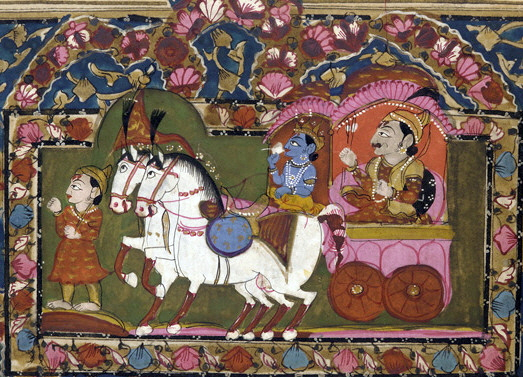
And last but not least, in support of Nandy, one only has to turn to the complex stories that are part of a famous Indian epic.
How much do you know about the deceit that embroils so many characters and stories of Mahabharata? Take for example the story of Drona and the crafty deceit involved in killing him – positively Machiavellian! Just one of the many, wondrous, intricate, interwoven stories of this famed epic from India. It tells you a lot about human (and godly!) nature, and would not have been the epic that it is without…lies.
 :
:
Really, Mr. Nandy, look what you started now!
:
:
:
:

 The Yin and Yang of Life Anywhere