Blog Archives
A Short Summer Visit Back Home. Sweet Home.
It’s finally here!
It’s time for my next visit back home. The last time I was here, it was early spring. Since then, I’ve missed some violent storms – tornadoes that destroyed property and lives being the worst. But now it’s summer. Hot and still sprinkled with storms (of a less scary kind this time) – thunderstorms. The fresh green of spring has evolved into the bright, dark and rich healthy green of summer that is broken up by the colorful hues of wild flowers everywhere.
Early this morning, I did not wake up to the sounds of car horns honking, sputtering autorickshaws or the namaaz/chants of the nearby mosque/temple blaring. Instead, it was just a natural wakefulness to the sounds of silence. As a replacement for the city that never sleeps, I woke up in a sleepy and peaceful southern US city. Vive la difference!

On my long journey back here, for some reason, I found myself reflecting back to the first time I ever entered these US shores many, many, many years ago and how different my feelings were then.
Now, I was simply returning home – to my own very comfortable environs.
Then, I was entering unknown territory, as perplexed and scared as anyone who found themselves in a strange country would be. As strange as anything, and as different from my native India as a place could be. I was all alone, about to join my newly acquired husband (poor guy!), another stranger, in a land of peculiar and different people.
What was I doing here? Unbelievably young and totally confused, completely unsure of where my future was headed. When I think back to those days and who I was then, here are some of the descriptors that come to mind (without any exaggeration, mind you): Naive, sheltered, unprepared, gauche, raw, green, ingenuous, and possibly the most apt descriptor of all, clueless. When I look at today’s 16 and 17 year-old kids, they seem so much more sophisticated, mature and worldly-wise than I felt then. Why is that?
The date indelibly stamped on my brain (Oct 13), what I experienced then were such powerful feelings and emotions that I have never forgotten them. Not even in all these intervening years while so much was going on, and as I grew up and made my new home, family, profession, new friendships, life.
How the years have simply flown by! After living in the US for some time, how easily I adjusted to the busy, new life I was making for myself! To the point where somewhere along the way, this became home, and India became my old, forgotten reality that was interspersed with relatively short visits to see my family.

Frankly, I never ever even considered that there would be a time when I would return to India to make yet another new life.
Today, after a few months of doing so however, I consider the recent change as a platform for new opportunities and fresh experiences. Where before, staying in one place and especially in the US, might have been construed by me as secure and stable, I find that this latest experience in India is actually giving me a good balance. It is giving me new ways of looking at life ahead since the world is transforming so fast – key among the countries undergoing transformation (in dissimilar ways) being the US and India.
Surprisingly, I also find that change can actually be quite exhilarating at this point in my life. Surprising, because I’ve always heard it said that as you grow older (and presumably wiser), you actually tend to resist change. Perhaps it’s because the stability that I need is not disappearing anywhere, since I know that I can always come back home whenever I wish to.
Plus, my closest family and friends span the world and are spread out in many cities and states in these two countries – New York, Bangalore, Manipal, Las Vegas, Los Angeles, Boston, Connecticut, Hyderabad, Alabama, Atlanta, New Jersey, Mumbai and so on. It’s a fact that globalization is making the world smaller with the internet allowing us to always be closely connected to people – wherever they may live.
Perhaps that is why such a dramatic change in geography is so much less daunting that it would’ve been, even a decade ago. I can Gchat and FB and Skype and email (but not quite tweet) with the best of them, while not missing a beat. Yes, I think that is why my recent life change is so much easier to deal with. The many means for effortless communication that exist today do make a difference.
But, of course, nothing, not even virtual reality, can surpass the physical reality of being in a place. (Yet).
So, I will relish and make the most of this short visit, using it to get back in touch with everyone and everything that I miss from here – until it’s time to return (in less than a week – yikes!). Knowing that I will be back for my next break in the U.S. in a couple of months makes it so much easier on the spirit!
Interestingly, I am doing the same while in India, i.e. relishing the time that I spend there. And appreciating the yin and yang of it all…
Here’s what I really feel. There’s something to be said about an attitude where you can reap the benefits and the best of both worlds, as they say. But for that to happen, I’ve found that this really needs to be more than an overused cliche. It needs to mean something to you. When you start feeling and appreciating the good things in each dimension, then, and only then will 2+2 add up to me so much more than 4. And, this makes it all worth it.
:
Photo By Wknight94 talk (Own work) [GFDL (www.gnu.org/copyleft/fdl.html) or CC-BY-SA-3.0 (www.creativecommons.org/licenses/by-sa/3.0)], via Wikimedia Commons
What are we teaching our kids?
There’s something I really appreciate about American culture and kids (there’s also lots I don’t, but that’s a story for another day).

First Lady Michelle Obama with children at Fort Bragg, N.C. in 2009
It is about how Amercian culture teaches kids to be independent rather early in life. For immigrants from other cultures, including India, this just does not come naturally. But most have adapted.
Specifically, you see young teenagers beginning some productive work earlier in life than what you would see elsewhere in the world. This may be with regular household chores or by being a paper boy or participating in a Boy/Girl Scout car wash during the weekend. It goes further than this. As they enter high school, kids find work during the weekends or summers. It might be about a service job in a fast food restaurant or hotel, or tutoring younger children in math, or helping coach basketball or working as interns (an outstanding concept this!) in businesses or with government organizations.

Young interns working for the National Museum of the U.S. Navy
Here are just some of the benefits that they end up receiving:
- Opportunities to meet new and interesting people.
- An appreciation for work, and hard work.
- Pocket money and independence from having to ask mom or dad to support their hobbies, be it music or books or games.
- Better social skills and the ability to communicate with adults and kids alike.
- A keener appreciation and value for fun times or non-working hours.
- Exploring new interests
- Thinking about their future and what they might want to do in life, sooner rather than later.
Let me tell you what I see in India. Note: This is from my limited recent exposure. Plus I am focusing on the upper-middle to wealthy class of families here. I get the impression that these children are given everything. They are pampered. They are given a good education. They are provided extra-curricula activities. They are given the ability to socialize and entertain their friends (paid by the parents), they are given pocket money or taken shopping so they can get what they need or want. They go to the movies or restaurants or clubs or other entertainment. And, as they grow into teenagers, it only gets to be more.

School girls on a field trip outside Taj Mahal Palace Hotel, Mumbai
It is rare for the child of this class of family to hear the word “No”. After all, they need to fit in with all their friends and the parents need to fit in with their peers. On the one hand, it’s nice to see the child getting all he needs and wants. But isn’t there another side to life and one’s responsibilities?
By not getting an up close and personal perspective of working life early on, look at the benefits that they miss – in their prime period of growth and learning. It would be so nice to see a transference of this aspect of life from the U.S. to India. After all, we have transferred McDonalds, KFC, Subway and the uber-consumer mindset from there to here, surely this can happen too?
So, there’s my view on one side of India that I see.
:
Moving to the poorer side of Indian society, there’s a totally different side I also see, that actually contradicts what I just said about kids not working in India. It’s the life of the child laborer in India. This is a tragic sight that is visible everywhere. It is about working due to necessity and at all costs. It’s not to supplement education. It’s instead of education. It’s often the only way for the child to have food to eat or shelter for the night.
Even though it is theoretically “illegal” as has been declared by the government, child labor is widespread, with examples that include household help, factory labor, hard labor in construction, hawking cheap goods and begging for cash (this is a job too!).
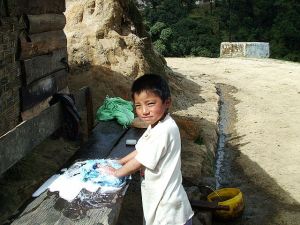
Child laborer in domestic work, India
The statistics are startling. According to one source:
India has the largest number of children employed than any other country in the world. According to the statistics provided by The Government of India around 90 million out of 179 million children in the six to 14 age group do not go to school and are engaged in some occupation or other. This means that close to 50 per cent of children are deprived of their right to a free and happy childhood.
Unofficially, this figure exceeds 100 million but the fact that a large number of these children work without wages in fields or in cottages alongside their parents, unreported by census, makes it very difficult to estimate accurately. However, it is estimated that if these working children constituted a country, it would be the 11th largest country in the world.
This situation, quite the opposite of what I described earlier, simply makes one want to weep at the injustice of it all! But what would be the the use of that?*
There are various NGOs who are working to reduce this tragic situation, the most notable among them being CRY (Child Rights and You). Commendable accomplishments by CRY abound. As an example, in 2010-11 alone, they have impacted the lives of almost 900,000 children in over 5000 villages and slums – moving them from child labor to schools and shelter. Any progress is great progress!
:
So, here I am.
I started down one path and ended up entirely somewhere else. It leads me again and again to that same state – the yin and yang of life in India.
In a country of so many dichotomies, what’s one more?
:
* If you wish to help this situation, one simple way to do this is to visit CRY and donate online. This is what your donation (even a small one) could accomplish:
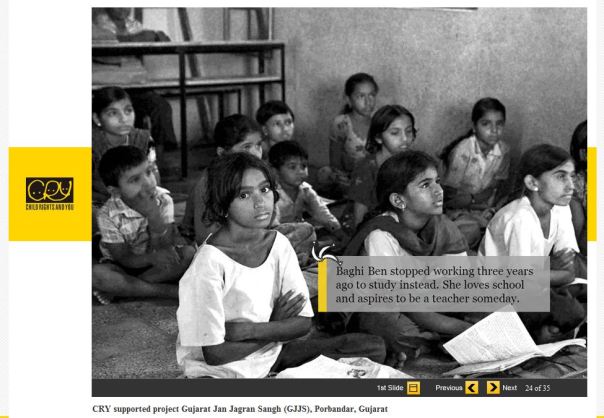
Note that I have no affiliation with CRY except as a donor (possibly a fellow donor?). Honestly speaking, this is not anywhere near what this post was supposed to be about! It literally just happened as I was writing. But I’m glad it did.
:
Photo School Girls: By Wen-Yan King (Flickr) [CC-BY-2.0 (www.creativecommons.org/licenses/by/2.0)], via Wikimedia Commons

 The Yin and Yang of Life Anywhere