Category Archives: Food
How much do you know about the Dabbawalas of Mumbai?
They have had a documentary produced by BBC and have been featured by, among others, The NY Times, Wall Street Journal, Forbes magazine, Harvard Business Review (case study), IBS (case study), The Economist and Seth Godin to name a few, but how much do you really know about the Dabbawalas of Bombay?
I am merely one more of many fascinated onlookers and this is my attempt to bring together a bit of the best that I’ve learnt about the amazing dabbawalas of Mumbai. I am also one among many bloggers who have written on this topic – without even searching very far, I quickly found about 50+ blog posts that referred to Seth Godin’s blog about dabbawalas! What’s one more? Perhaps it will entice you to go to the source and read some more….So, here goes:

Dabbawala of Mumbai
First some facts –
A dabbawala in Mumbai carries freshly packed lunch in a box (dabba) from a person’s homes to his office.
5000 dabbawalas carry 200,000 lunch boxes every day (400,000 transactions: pick-up + drop-off), growing from a service that originated in 1890 with 100 dabbawalas.
The charge for this service is approximately $6.00. Per month!
Their error rate is an amazing 1 in 16 million transactions for which they have been recognized with Six Sigma performance (99.999999% error-free).
Their modes of transportation during their work day includes bicycles, push carts, and public trains.
They have a hub and spoke system (think Fedex) – a collecting dabbawala, and a local (delivering) dabbawala. They have a simple color coded system that determines the destination of each lunch box.
Their use of modern technology is almost non-existent although lately they have been using SMS for convenience.
The service is virtually uninterrupted even in severe monsoon weather.
When you consider that Mumbai is one of the most densely populated and large cities in the world with a complex transportation network and huge traffic flows, you can easily see why this service would be needed and in much demand. No one wants to brave the traffic or weather at lunch!
The alternative is a fresh, hot home cooked meal brought to your office at lunch time…yummy! So, yes, the demand for this service is easy to visualize. But what is more amazing is that this same over-crowded, overflowing city of Mumbai is also the hub of such well-coordinated activity and flawless delivery. In fact, “amazing” as a descriptor just doesn’t cut it!
Seth Godin says –
The reported error rate is one in six million.
How is this possible? How do you create and run a service with thousand of employees, no technology and a poorly-educated workforce and have better than six sigma quality?
Simple: the dabbawallas know their customers. If they rotated the people around, it would never work. There’s trust, and along with the trust is responsibility. By creating a flat organization and building relationships, the system even survives monsoon season.
According to The NY Times –
The precision and efficiency of the dabbawallas have been likened to the Internet, where packets identified by unique markers are ferried to their destination by means of a complex network.
…
The secret of the system is in the colored codes painted on the side of the boxes, which tell the dabbawallas where the food comes from and which railway stations it must pass through on its way to a specific office in a specific building in downtown Mumbai.
The Economist writes –
… the 5,000-strong dabbawala collective has built up an extraordinary reputation for the speed and accuracy of its deliveries. Word of their legendary efficiency and almost flawless logistics is now spreading through the rarefied world of management consulting. Impressed by the dabbawalas’ “six-sigma” certified error rate—reportedly on the order of one mistake per 6m deliveries—management gurus and bosses are queuing up to find out how they do it.
:
As I said, this is fascinating stuff! If you are too busy to check out any of these sources, take less than four minutes to see them in action in this short video or this even better longer one at 10 minutes. It will be worth your time, I promise!
:
Photo: By Joe Zachs from Pune, India (The Bombay Dabawalla) [CC-BY-2.0 (www.creativecommons.org/licenses/by/2.0)], via Wikimedia Commons
Pilgrimage to Bandra
I don’t quite remember which Mumbai friend first introduced me to Pani Puri at Elco Market in Bandra. Whoever you are, I am eternally grateful. Over the past couple of years, as I visited Bombay on my bi-monthly business trips, I would always somehow make time for my pilgrimage to Bandra and Elco Market. Now that I live here, I am trying to limit my pilgrimages to one weekly trip.
I didn’t even know how much I liked pani puri until I tried this dish here. It’s technically street food. Here at Elco, you have a sense of cleanliness (real or imagined). The guy who’s actually dishing out the pani puri wears a clean ,disposable glove – at least on the one hand that dips the puri into the spicy and sweet water to make it whole and complete. And, I heard (but never verified) that they use bottled or filtered water to make the pani. That can be pretty important. But nothing is quite as important as sheer taste!
For the uninformed and uninitiated, Pani Puri consists of taking tiny, crisp puris and dipping each in an equal amount of sweet/tart and spicy water, then handing it quickly over to the customer. Included in the puri will be a small amount of boiled lentil. Said customer then puts the entire water-filled puri in his or her mouth and gulps it down. At Elco, they don’t serve you a plate where you make your own. You stand around the pani puri counter where the pani puri guy makes each masterpiece himself – with just the right amount of sweet and spicy water – for you to wait your turn and just gobble down.
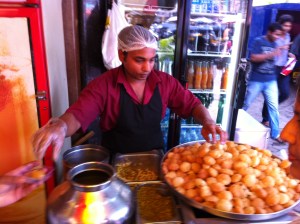
Seshram Serving Up Delicious Pani Puri at Elco Market; Photo by vishalphotography.com
One “plate” of pani puris at Elco consists of six servings or puris. Most people settle for one plate and then branch out to some of the other goodies that are being freshly prepared. Some graduate to maybe two plates and you can sometimes see on their faces that that was more than they had bargained for.
But not moi. If I don’t have three full plates at each visit, then there’s something truly wrong with me. Each tiny puri is power-packed with taste and flavor. It is crisp yet succulent. It is spicy yet sweet. It is minimal yet full. It is simply, food ecstacy. Of course, this is just my humble opinion. You would think I am describing something else altogether! But, I insist that I’m not.
On your next visit to this city, see if you can find some time to make your own pilgrimage to Elco Market at Bandra. It will be worth it. This review shows what other goodies you can find there. And, here at this photo blog is another great picture of the pani puri at Elco (scroll down and you can’t miss it!), in addition to some wonderful and colorful pictures of Mumbai. Enjoy!

 The Yin and Yang of Life Anywhere