Category Archives: recommendations
Seven Minutes.
To all like-minded people! By that I mean those who, whenever they think of exercise, think of excuses or pain…
I’m excited, I think I’ve found something new that can overcome your resistance!
For most of my life, I have done well with overcoming resistance to physical exercise. Years of gym memberships, exercise buddies, after work group classes, loving zumba, discovering yoga, obsessing over surya namaskars…
Really, when I look back, I have done well [pat on my back].
But. For the past two years, during a time when I needed it more than ever before, I’ve slacked off. Yes, I restarted a regular 15 minute yoga routine every morning but still, I’ve slacked off in general, and I can feel it.
Between work, travel, and commuting between two homes in two cities every week, time has been at a premium. Yes, I know – what a mundane, overused excuse that is! But it’s worked for me (or not worked, depending on how you look at it). 😦
Then, a couple of months ago, I read a NY Times article on the seven minute scientific workout. My eyes and brain focused and attached themselves to two things:
1. SEVEN MINUTES
2. SCIENTIFIC
(The second one was important, but it stuck out to a much lesser extent than the #1 benefit above)
I decided to myself that even I could commit to this. How can anyone come up with a plausible excuse for giving up seven minutes out of a 24 hour day? Even I couldn’t get that creative!
Still, it took me a couple of months to do anything about it.
Of course, there’s an app for it! Actually, there are a bunch of apps. Just go to your app store and search for “7 minute workout”.
I found my app through a facebook targeted ad. Imagine that! I tell you fb is big brother watching over you…how did they know??! On the other hand, if you are a shareholder of fb, hey, these targeted ads do work! Hold on to that fb stock, this can only get better and more profitable for them over time.
Anyway, the reviews on this particular app were so off the charts, I relented and plonked down a hefty fee of $1.99 for it. [It’s this one, btw. After my heavy investment, I actually found a free app that had even better reviews].
I’ve now been using it for only just over a week so I am probably not the best one to review it. All I can say is that it is an extreme, hard workout for seven minutes. And it makes me feel great once I’m done. Like I’ve really accomplished something.
The theory behind this international hit/fad/workout is as follows.
It all appears to have started with this research article in the American College of Sports Medicine. [You can click on the picture below to read this paper].
:

:
Here is the condensed version, quoted from this paper:
Time and access to facility constraints can be a concern when it comes to getting people to exercise. High-intensity circuit training (HICT) seems to deliver numerous health benefits in less time than more traditional programs that are recommended. Furthermore, body weight can be used as resistance, eliminating the need for specialized facilities or equipment.
:
Some of the specific benefits of HICT (again, quoted from the paper) are these:
- HICT can be a fast and efficient way to lose excess body weight and body fat. Research has found that these metabolic benefits can be present for up to 72 hours after a high-intensity exercise bout has been completed.
- HICT may be an extremely effective and efficient means by which to increase an individual’s V˙O2max, a well-established marker of cardiopulmonary health.
- HICT can be an efficient approach to decreasing insulin resistance as well — a major factor in developing type 2 diabetes
:
And finally, also according to the paper with my highlights:
To address the limitations of traditional exercise protocols and provide an effective and efficient program for our clients, one of the exercise strategies we use is high-intensity circuit training (HICT) using body weight as resistance. Our approach combines aerobic and resistance training into a single exercise bout lasting approximately 7 minutes. Participants can repeat the 7-minute bout 2 to 3 times, depending on the amount of time they have. As body weight provides the only form of resistance, the program can be done anywhere.
:
HICT is not a new concept, but it is growing in popularity because of its efficiency and practicality for a time-constrained society. The combination of aerobic and resistance training in a high-intensity, limited-rest design can deliver numerous health benefits in much less time than traditional programs. When body weight is used as resistance, it eliminates the limiting factors of access to equipment and facilities.
:
To understand the benefits, methodologies, and supporting research with regard to HICT, I suggest that you read this paper in its entirety (it’s not that long or complicated).
:
And finally, here are the actual twelve exercises (picture reproduced from the NY Times article on this topic). There are twelve in all, and for those seven minutes, it will be beyond tough. It is tortuous. But worth it, I hope and certainly from what I have read so far.
:
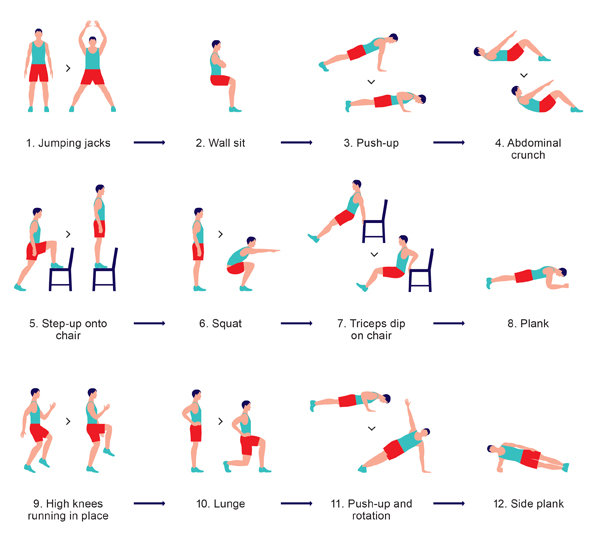
:
Try it out, why don’t you? Seven minutes. How can you say no? If I can do it, anyone can.
Let me know how it goes!
:
:
It’s Brain Time, Folks
I have a selfish reason for writing this post. I intend to send it to all my loved ones – friends, family, people I know. It saves me time having to speak about this topic repeatedly or not always articulating it the same way.
Bottom line, all it is really is a book recommendation.
But if even one out of a few people take my recommendation and read this book, I will be thrilled and they will not be sorry. Really, I shouldn’t need to promote it since it has been on virtually all the top bestseller lists in the US. But just in case you have not heard about it, I want to give it a shot here.
I just completed reading the book. While I was already kind of on the path this book talks about, I still learned quite a bit.
The notion and conventional wisdom that fat is bad for you but carbs are good has been a pervasive theme over most of my lifetime – hah, just ask the USDA and most major pharmaceutical and food companies!
About eight years ago, all in an attempt to lose weight, I started on a journey of Atkins (one of a few low-carb life style diets) and have not looked back since. People may look at me strangely but it’s a life style choice that I have never regretted. I’ve cheated a few times, most recently when I devoured those delicious baguettes in Paris…but those times have definitely been the exception.

Today, finally, mainstream media and slowly, the medical community is catching up with promoting what’s what – that carbs are like poison that invade your body, not leaving you in the same healthy place you were before, nor do they take you where you need to be.
It’s not just about losing weight. It’s about everything else that impacts your physical health. Or that’s what I thought.
As people age or their loved ones do, they worry about their health more than anything else, including wealth. Increasingly, I find people worrying not just about their physical health but about their mental health – about potential health scares such as dementia, Parkinson’s, Alzheimer’s which are more alarming and chilling than most anything else. Who knows what may strike? And when?
Little did I know how badly carbs impact the brain too! Until I read this book.
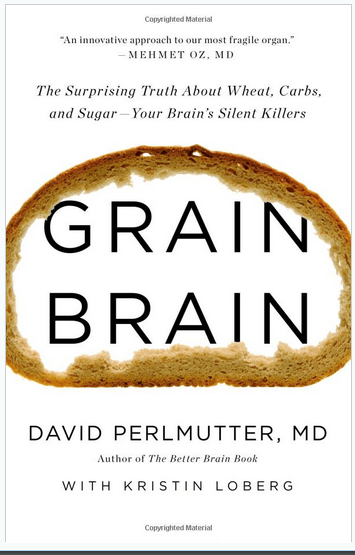
Sure, it’s your choice on whether to read it. But I simply cannot over-emphasize how important the contents of this book are to help you understand and protect your brain’s health.
Read it to learn some of these counter-intuitive facts each of which is backed by compelling research and references. [All quoted text below is taken directly from the book and is copyrighted material; it is used here to showcase the contents and motivate people to read the book]:
- “…the fate of your brain is not in your genes. It’s not inevitable. And if you’re someone who suffers from another type of brain disorder, such as chronic headaches, depression, epilepsy or extreme moodiness, the culprit may not be encoded in your DNA. It’s in the food you eat“.
- “The origin of brain disease is in many cases dietary”.
- “To a large extent numerous neurological afflictions often reflect the mistake of consuming too many carbs and too few healthy fats“.
- “The studies describing Alzheimer’s as a third type of diabetes began to emerge in 2005, but the link between poor diet and Alzheimer’s has only recently been brought to light…”
- “These studies are both convincingly horrifying and empowering at the same time. To think we can prevent Alzheimer’s just be changing the food we eat is, well, astonishing”.
- “I’m going to show you how to control your genetic destiny…”
- “This will require that you free yourself from a few myths so many people continue to cling to. The two biggest ones: (1) a low- fat, high-carb diet is good, and (2) cholesterol is bad”.
- “…you’ll soon understand why cholesterol is one of the most important players in maintaining brain health and function. Study after study shows that high cholesterol reduces your risk for brain disease and increases longevity“.
- “By the same token, high levels of dietary fat (the good kind, no trans fats here) have proven to be key to health and peak brain function.”
- “…we tend to get mentally wedded to ideas that are no longer valid“.
- “I watch people devour gluten-laden carbohydrates, it’s like watching then pour themselves a cocktail of gasoline. Gluten is our generation’s tobacco“.
- “…look at how carbs in general raise risk factors for neurological disorders, often at the expense of our brain’s real lover: fat. When we consume too many carbs, we eat less fat – the very ingredient our brain demands for health“.
- “No diet will remove all the fat from your body because the brain is entirely fat“.
- “Unfortunately, most of us equate the idea of eating fat to being fat, when in reality, obesity – and its metabolic consequences- has almost nothing to do with dietary fat consumption and everything to do with our addiction to carbs“.
- “The same is true about cholesterol: Eating high-cholesterol foods has no impact on our actual cholesterol levels, and the alleged correlation between higher cholesterol and higher cardiac risk is an absolute fallacy“.
- “Respect your genome. Fat-not carbohydrate- is the preferred fuel of human metabolism and has been for all of human evolution”.
- “…the Journal of Alzheimer’s Disease published research from the Mayo Clinic revealing that older people who fill their plates with carbohydrates have nearly four times the risk of developing mild cognitive impairment (MCI), generally considered the precursor to Alzheimer’s“.
- “…those whose diets were highest in healthy fats were 42 percent less likely to experience cognitive impairment;”
- “…researchers in Netherlands found that the Alzheimer’s patients had significantly reduced amounts of fats, notably cholesterol and free fatty acids, in their cerebrospinal fluid than did the controls”.
- “High cholesterol is associated with better memory function”.
- “…showed that people with the lowest LDL cholesterol (the so-called bad cholesterol) were at increased risk for Parkinson’s disease by approximately 350 percent!”
and finally, my last quote from the book (although I have so many more highlights throughout this book!) –
- “The diet heart hypothesis that suggests that a high intake of fat or cholesterol causes heart disease has been repeatedly shown to be wrong, and yet, for complicated reasons of pride, profit, and prejudice, the hypothesis continues to be exploited by scientists, fund-raising enterprise, food companies, and even governmental agencies. The public is being deceived by the greatest health scam of the century“.

Healthy? Think again.
By the way, I am in no way affiliated with the author, the publisher or anyone having anything to do with this book. After reading the book, I have merely become one more (very grateful) fan.
Do me a favor. No, actually do yourself and your loved ones a favor – go get this book and read it! Unless you read this book in its entirely, this is just a list of claims that you read somewhere on a blog and that you will quickly forget. You need to make the investment of time to read it all – not just the hypotheses but the strong back-up to each that is provided. Only then will you get closer to believing.
More than anyone, I wish that current and aspiring medical professionals who touch so many lives every day would read it. Even if its just to have a healthy debate about the conclusions.
This is one of those rare books that has been an absolute game changer for me, and I guarantee the same for any one else who reads it.
Health, especially that of your most important organ is too pivotal to ignore. This has taught me one other thing – that you would be wise to question conventional “wisdom”. All the time.
:
:

 The Yin and Yang of Life Anywhere