Category Archives: india
In India, Marriages are Made in Heaven. Or Shaadi.com
There’s Change. And then there’s Change.
India is a-changing. Rapidly. I’m not sure how many times I’ve written this. It’s becoming rather boring, even to myself, to keep repeating this mantra. But, what can I say? It’s what has happened to this country during the long period when I was living elsewhere, oceans away.
For change to be pervasive or significant, you have to imagine what it means for a nation of more than 1.2 billion people. Kind of like the changing of direction of a massive ocean liner. It won’t happen in the blink of an eye. But over a couple of decades? No question about it! In so many aspects of life, work and living in India – change is visible, dramatic and immense.
But not so much in the case of Indian marriages. In this case, there’s probably been more of a very slow evolution, than any kind of revolution.
The Curious Case of Arranged Marriages
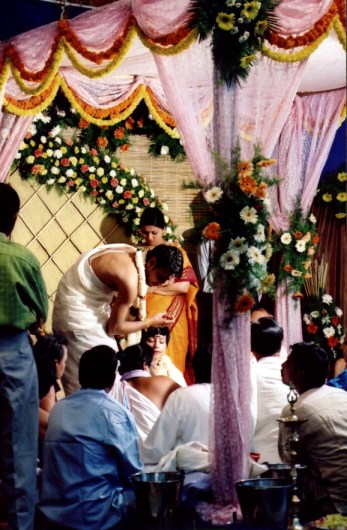 This has been a country of arranged marriages over the ages, specifically way back since the fourth century.
So, just because the country has opened up to the West and just because of global mass media and communications, it doesn’t mean that centuries of tradition can or will become undone, especially when it comes to such life altering decisions.
Sure, there are some changes, especially in the metros, where marriages of ‘the other kind’ [regularly referred to as “love marriages” 🙂 ] seem to be more commonplace, but even in the metros, arranged marriages continue to rule the roost.
Marriage is still considered in India as uniting families rather than individuals.More of a family alliance than a union between two souls, that’s for sure.
These arranged marriages originally became a practice for the elite in society to maintain their high status. Gradually it became pervasive in Indian society in general, where each class sought to maintain its respective status.
A Central Fabric of Indian Society. But Why?
According to sociologists who have studied this broad phenomenon in India, historically and even today, arranged marriages serve various purposes in most of the diverse communities across India.
1. Maintains social status and satisfaction
2. Gives parental control of children’s futures
3. Preserves ancestral lineage
4. Provides an opportunity to strengthen the family sub-group
5. Allows the consolidation and extension of family wealth and property
6. Enables the preservation of endogamy, the practice of marrying within a specific ethnic group, class, or social group, rejecting others (on such a basis) as being unsuitable.
When you think about this carefully, it’s easy to veer from the good to the ugly. It’s a dichotomy. On the one hand, you have something that is very practical. On the other hand, that same something is also rather cold. And, where in all of this is there any room for that concept called romance?
The Modern Matchmaker
Into this old country with timeless traditions, enter shaadi.com (Note: “Shaadi” in Hindi means wedding).This was back in 1996. The founder, Anupam Mittal was a single guy who was having trouble finding the right girl to marry. So, he decided to marry technology to tradition and create shaadi.com. Or so the legend goes. From what I have read, he has remained single. But that has not stopped him from being the online facilitator and the “arranger”, so to speak, of countless Indian arranged marriages.
You have seen companies that have mission statements that speak of various prosaic or esoteric missions. For example, there are some staid one’s such as Microsoft’s
“…Helping People and Businesses to Realize their Full Potential”. Oh…kay.
Or something fun, like Zynga, the games company, which describes itself as such –
Zynga wants to give the world permission to play…
That’s pretty neat. Still, shaadi.com has a higher purpose. Here is how it describes itself –
… using our services to find happiness.
It goes without saying that these folks equate marriage with happiness. Some would say that was a pretty contentious stance to take. But not many in India, I dare say.
This online marriage broker is obviously doing something right in this country of a billion plus people. This site is ranked in the top 10 most visited sites of India. They’ve hit a sweet spot, for sure.
Besides, it was also ranked as the most innovative company in India by Fast Company. Perhaps that’s because of the the way it applies technology to marriage – making it easy to use, safe, private, comprehensive – offering a whole host of variety, selection criteria, and ultra customer-focused.
So, how does it work?
Essentially it’s like a dating service except that there is only one real goal: M A R R I A G E. You can think of it as a dating service customized for Indians, with all the quirks and traditions that they are used to and need.
Versatility, Thy Name is Shaadi.com
In India, it’s not always the individual to be married who submits a profile on shaadi.com. Carrying its well-established tradition forward, it could be parent(s), sibling or some ‘elder’ in the family who decides that the candidate wants marriage. So, essentially, in these cases, you have just moved an “offline”, analog process to be online and digital. According to the site, a whopping 30% of profiles are submitted by someone other than the marriage prospect. This goes back to my theory that the ‘business’ of marriage in India has not changed much over the centuries.
No doubt shaadi.com is providing a valuable service to a country that is still very traditional in its approach to marriage and life in general, by using technology to expand the universe of the prospective groom or bride (or their parents) to find their mate for life.
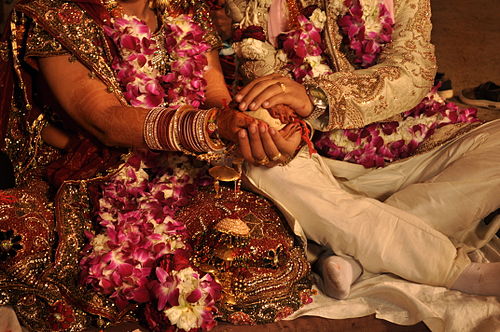
In addition to helping the traditionalist, there is also something liberating about this process because even as this site enables the conventional Indian approach to get results, it also offers an opportunity for people to move beyond caste, community, religion and language – should they choose to do so. For example, perhaps an individual chooses to find and meet someone who has similar interests, rather than similar castes or backgrounds. They can do so now in the privacy of their home unleashing the power of their advanced search feature…all at their fingertips!
The service uses a subscription revenue model but I have yet to find any financials of this private company. However, with 15 years of history, this company has managed to touch over 20 million Indians globally and claims to have arranged a whopping 2 million marriages. Wow!
In addition, they have a mix of 70% Indians living in India and 30% Indians living outside of India. They have an impressive six million unique visitors every month with three million active members currently. The ratio of male to female between the ages of 21-35 is 65 to 35% – I’m not quite sure what conclusions to draw from this difference.
Shaadi.com may be the most well known and successful marriage site in India, but as you can imagine in this massive market, there’s room for copy cats, some backed by big name companies. So, here are a few more with some interesting names-
jeevansathi.com (“lifelong friend”)
simplymarry.com – labels itself as the first “metro-marriage” site.
bharatmatrimony.com (“bharat” – another name for India)
vivahabandhan.com (“marriage bond”)
marriageexpress.com – Hmmmm, that sounds kinda fishy….
and of course, secondshaadi.com. Why ever not?

:
Photo credit – Traditional Indian Wedding: http://upload.wikimedia.org/wikipedia/commons/thumb/b/bd/Indian_wedding_Delhi.jpg/500px-Indian_wedding_Delhi.jpg
India’s Independence, Corruption and a Reason for Hope
Reprise
If you happen to be in India and have read the newspapers today and over the past few days, you know that things are heating up again regarding the pending Lokpal legislation and heading towards another showdown. The government is pushing to get the Lokpal bill tabled in Parliament before the session ends at the end of this month. But Anna is furious. He thinks it doesn’t have legs. So, on December 27th, Anna promises to go on another fast – this time it appears in this city of Mumbai.
He says, “This is not a strong Lokpal Bill. The CBI (Central Bureau of Investigation) is out of the ambit of the Lokpal. We will continue our fast plans and during the next general elections, I will tour the entire country.”
Arvind Kejriwal adds, “It is the biggest joke I’ve ever heard.”
While Kiran Bedi continues, “Have you ever heard of creating an investigating body without any investigating body? Are we dumb citizens who can be given anything? This kind of Lokpal be better not passed or else it will destroy whatever is left of CBI. The government is creating an anti-corruption body without any where withal for investigation. Who is fooling whom?”
Santosh Hegde also rejected the Government’s Lokpal Bill. Here is his viewpoint: “The Government version is totally unacceptable. What is the point in having a Lokpal like this? You cannot check corruption if Lokpal has no powers. No one is setting a deadline to Parliament. They only said they’ll pass it. If they can pass 17 Bills in 12 minutes they can pass this easily. The agitation will continue against corruption. Is FDI in retail more important than fighting against corruption?”
[Read below more about Kejriwal, Bedi and Hegde – key members of Team Anna].
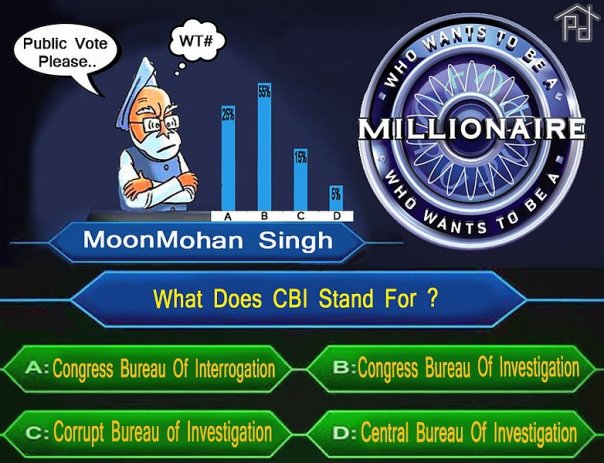
Cartoon by Pappu Dehati; posted to India Against Corruption Facebook Page.
It really pays to remember what this country is fighting for, and who the key fighters are for this very public cause! So, I decided to re-publish this post which first appeared on India’s Independence Day this year.
Take it for what it is
First, you can take this for what it is – the views of an Indian-origin expat living in modern India after a long interval. After all, what can I know that the Indians who live here don’t already know and know well? But, this is less about knowledge and more about perspectives. And these are interesting times. So, since it’s a free country, here I go again, recording my perspectives and views… sometimes, delving deeper than I should.
Modern India’s Recurring Theme: Corruption
In India, over the past few months, there has been a battle raging on the ground to halt pervasive corruption among the political class of India. Shameful scams, public scandals, impotent leaders and blatant fraud have been the colors painted on the canvas of India, robbing its people of essential services, growth and the ability to develop. I firmly believe that the anti-corruption cause and its outcome will truly determine the pace and extent to which this country’s awesome potential can be realized. It’s that crucial and essential a fight (it’s also quite sad that it needs to be a fight).
We have heard a lot about Anna Hazare – his leadership and his strong will towards this cause that has in turn galvanized the nation and is creating a groundswell movement in India. What has been especially uplifting to see is how this one 75 year old man has been able to energize the youth in the country (just go to fb and do a search for “anna hazare” and you will know what I mean).
But, it takes more than one leader, it takes a village. How much do you know about some of the other luminaries who are working with him to take this cause forward? “Luminary” is not so far from the truth. This handful of people have credibility that simply shines through; they are less about limelight for themselves, and more about fighting for causes that matter to the common man of India.
 Team Anna
If there is one overriding reason why you should support Team Anna, it is precisely because of the people who make up the team, starting with Anna. Most of them are part of the Lokpal joint drafting committee (that was anything but joint).
With them on your side, you and the country are in good hands. Let me tell you why, by telling you who.
All of them belong to civil society. What is that anyway? You can read the full definition on wikipedia but here’s the gist of it:
Civil Society is composed of voluntary social relationships for un-coerced collective action around shared interests, purposes and values. Or more simply, the arena, outside of the family, the state, and the market where people associate to advance common interests.
Now, here are some civil society members who are actively working to reduce and ultimately end corruption in India. And, as you can imagine, it’s not a simple fight. On the surface, this appears to be the duty of the government. But, how does a corrupt government do its duty to end corruption? Therein lies the dilemma!
Recognizing The Creme de la Creme
All five of the civil society members named below have, over time, received numerous national and international awards, recognition and commendations. They are tireless in fighting for their causes, all of which benefit the common man. They are admired for their accomplishments and respected for their efforts. They are truly national treasures of India and many in the country are just now coming to know them.
They are on your side. Do you know much about them? It’s not too late to find out. This post is not intended to give you their entire background. It’s more of an introduction (with links to more insight). It’s a taster to intrigue you to find out more – why they matter and why they need your support.
As I list them below, I want to also mention that I have deliberately not included Anna Hazare, as he was the subject of an entire previous post. He’s such an obvious one on this list that if you already don’t know much about him, there may not be much point in reading any further. 😦
I have chosen to simply alphabetize this list; all of them are equally noteworthy. Suffice it to say that the people of this country are lucky to have them on their side!:
 1. Arvind Kejriwal : “We are not ready to compromise with anyone till our demands are met. The deadlock continues. We are open for any dialogue but there is no invitation from the government yet”
He was instrumental in getting the Right to Information (RTI) Act passed in India as he strove to increase transparency in Government. He campaigned heavily along with others to gain this victory and RTI was eventually passed in 2001. Over the past months, he has taken a leadership role in anti-corruption and the proposed Jan Lokpal bill. Much admired and respected, Mr.Kejriwal is all about action to transform this country.
:
 2. Kiran Bedi : “Lokpal Bill drafted by the government is like the Lokayukta; it is powerless”
She is India’s first and highest ranking woman police officer. She joined the Indian Police Service in 1972 and retired in 2007. She is renowned for her innovative yet effective approach to law enforcement, through which she achieved extraordinary success in tough environments.Since retiring from active police duty, Kiran has also become an international activist on crime prevention, drug abuse, police and prison reform, women’s issues, and human welfare. She founded and runs two nonprofit organizations: Navjyoti and the India Vision Foundation., which provide education, vocational training, and treatment for drug addiction to women and children living in India’s slums, rural areas, and prisons.
:
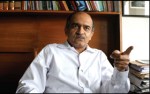 3. Prashant Bhushan :”The present version of the (Govt) Lokpal bill is useless as it will cause confusion and discourage the common man from complaining against corruption”
A lawyer by trade, he is well-versed in the judicial system of India. Outraged by corruption of judges, he has actively campaigned for causes related to ridding the judiciary of corruption. Some of the fights he has raged in his career – the Doon Valley case, where limestone quarrying was hurting the environment, the Bhopal gas tragedy litigation, and the Narmada case as well. He was the Delhi President of the People’s Union for Civil Liberties, India’s oldest human rights organisation. He also wrote a book on the Rs 64-crore Bofors scandal of the late 1980s, involving payoffs in the supply of howitzers to the Indian government.
:
 4. Santhosh Hegde :”I don’t find any reason why the PM should be left out and this proposal has been pending for the past six years or so. It’s no longer a contentious issue”
A true crusader against corruption, his current role as Karnataka’s Lokayukta demonstrates not just how dramatic the results can be, but also what persistence and boldness means. A former Supreme Court Justice, Mr. Hegde has already played a large role in the fight against corruption and by working with Team Anna is taking the cause to the national scene. His integrity is without question and his bold actions are to be lauded. A report constituted by the Lokayukta uncovered major violations and systemic corruption in iron-ore mining in Bellary that ended up (so far) with the removal of Karnataka’s corrupt Chief Minister.
:
 5. Shanthi Bhushan :“It was decided in the committee meeting that two versions of the lokpal bill will be sent to the cabinet. Let the cabinet see the two drafts and take a final call”
Prashant’s father 85 year old Shanti Bhushan was union minister for law in the Morarji Desai government (1977-79). They live in the same house in Noida. Both are outraged by the corruption among judges. But they also differ in many ways. He has been impressed by the achievements of the UPA Government in the past. The son on the other hand thought that the UPA Government was among the weakest that India has had. The father is not anti-America. The son is strongly against the US and the Indo-US civilian nuclear agreement. Together, they are formidable public warriors, among India’s best. Mr. Shanti Bhushan then as the Law Minister had introduced Lokpal bill in 1977, but it could never see the light of the day, because of the collapse of the government. He is a member of the committee constituted in April 2011 for the Jan Lokpal Bill.
:

Finally, Hope
At the dawn of another anniversary of Independence for the Republic of India, it’s time for citizens to be thankful for freedom in this country. True, there are many disappointments in how the country has shaped up in the years since Independence, but aren’t there just as many reasons to celebrate successes and stimulate hope?
So, in 2011, what I see in India is this: Anna Hazare and this team of shining lights of India as one unified and great reason for hope. The least you can do is give them your support, in whichever way it manifests itself.

 The Yin and Yang of Life Anywhere