Blog Archives
Mobile Usage: Here, there and everywhere!

Your mobile phone - Mahout, don't leave home without it!
I write this post knowing that it will likely get outdated quickly because of the blindingly fast pace of change in mobile technology. Even so, what has happened over recent years is simply amazing. What speaks better than numbers?
As I write today, there are some 6.9 billion or so people on this earth. Accompanying them are a whopping 5 billion mobile phone subscribers. Now, that’s what I call a Number with a capital N.
Coming to this country, India has the second highest number of subscribers in the world after China. Over the last half of the 20th century, while the Western world progressed in a logical fashion by getting everyone connected using land lines, India and much of the third world struggled with establishing the infrastructure needed for those types of connections. It was just not comprehensive enough because it was not an affordable investment for those governments.
With the advent of wireless technology and mobile phones, however, the third world simply leapfrogged the developed world and raced full speed ahead.
Anyone who has been to India can attest to the reality on the ground – virtually everyone here is connected via a mobile phone, and you can see them everywhere you look (not to mention hearing all kinds of interesting ringtones!).
But even so, when I started digging to find out more specifics that were quantitative rather than qualitative, the numbers were unbelievably huge. Here are some of them –

Today there are a staggering 811+ million wireless subscribers in India (that number is equal to ~67% of its population!).
Compare that to the mere 34 million land line subscribers in the country – equal to less than 3% of the population!
Moreover, India and China account for almost 50% of the total mobile subscribers in the world. So, when people talk ubiquitous, this is what it means.
According to a recent article by Eric Schmidt, Executive Chairman, Google that was published in Economic Times, Asia is the key for unlocking the mobile internet. Here are a few of his statements regarding this:
- Asia has been a leading innovator in mobile Internet technology for years.
- Asians are using services that would be the envy of many people in the US.
- The SMS is very much alive and well and doing more than ever before.
- Asia’s mobile community is converging on the open Internet from all sides, whether it’s through the SMS, the smartphone browser capable of rendering all Web pages, or open-source operating systems like Android.
- China is the second-largest country in terms of downloaded mobile apps.
- The expectation is that Asia will become a global hub for app development in a few years.
- We expect a billion people will have inexpensive, browser-based touchscreen phones over the next few years.
This will be a huge market for those making mobile apps – wherever in the world they are.
I will probably re-read this post in a few months and have to correct the facts above by increasing the numbers, but as of today, they are valid. Incomprehensible as they may seem…
Finally, I end with this fascinating excerpt from a write-up in The Economist (India’s Economy: The half-finished revolution):
“India has world-class information-technology exporters but imports lots of fridges; it has 15 times more phone subscribers than taxpayers; and in the coming years most Indians are likelier to be connected to a national, biometric, electronic identity-system than to a sewer”.
That’s what I call the yin and yang of life in India.
:
Man in Turban; Photograph by Harkanwal Singh. (Harkanwal Singh) [CC-BY-SA-2.5 (www.creativecommons.org/licenses/by-sa/2.5)], via Wikimedia Commons
Karnataka: The Unprecedented Descent
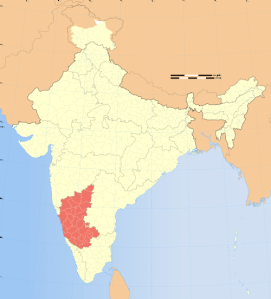
India Map Highlighting Southern State of Karnataka
What happened to Karnataka?
I have ties that go way back in Bangalore and Karnataka. Way back, when visitors would delight in the beauty of this Southern capital city, its perfect moderate climate, expansive greens and gardens, the well laid out infrastructure and the peace and quiet.
So. What happened?

Aerial View of Bangalore
Bangalore is being described as a dystopia. That means exactly what it sounds like, an “anti-utopia” or as far removed from utopia as you can get. And the state of Karnataka is characterized as one of, if not, the most corrupt state in the nation. Unbelievable! How could it go from that extreme to this one? What happened to being the rising star of India? The Silicon Valley, home of Infosys and a whole range of multi-national technology brands?
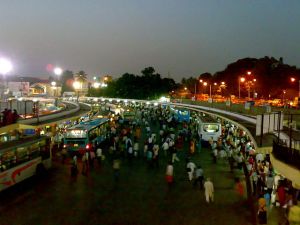
Typical Rush Hour in Today's Overcrowded Bangalore City
Explosion and Corruption
It exploded. It went out of control. And it became utterly corrupt. So sad to see! And so sad for the people who live there to have to live through this devolution. Yes, like dystopia, this is the opposite of evolution. One meaning of this word is “descent or degeneration to a lower or worse state”. What an appropriate meaning yet sad state of affairs for Karnataka.
How could a city and state that showed such promise and potential descend into these depths? That is the shame of the state, and if this happened to a one-time rising star of the country, the shame is shared by the entire nation. We want and need to see transformations that go in the opposite direction! [See why Bihar is worth celebrating in this respect. Yes, I said Bihar.]

1868 photograph of Bellary Fort
As I read the newspapers sitting here in Mumbai, the headlines this week are all about Karnataka and the current chief minister, commonly referred to as Yeddy. He has been asked to step down and leave by the party for illegal activities and corruption. So by the time this post is published, he should have departed. But not until after robbing the state bare – it’s treasury and the environment.
Bellary is the location in the state which has been ravaged for it’s iron ore in the mining scandal, leaving the earth and environment massively damaged. Indicted in the special report are the Reddy brothers who I first read about in the NY Times, of all places. Three brothers who have helped loot the state and the environment, not to mention becoming political power brokers (and giving all Reddys a bad name, to boot!) with two of the three continuing on as Ministers of the state!
And then, here’s the ‘funny’ part, there’s no shame or remorse exhibited by the people who have committed these transgressions. The independent investigation that was conducted alleges that $4 billion was looted from the state over a few years. None of the politicians are denying it. Instead they are pointing to the previous government and saying, “they did it, why shouldn’t we?”. Sick.
What is Politics After All?
Politics is simply a business in India today. Except it’s even better than successful private industry. It is a business where you can thrive and prosper in power, and where your return on investment is sky high. And one where the moral guide of the typical Indian politician is at an all time low. I hate to contemplate that it can perhaps sink to even lower depths.
And that’s the sad other side of the story of India Rising.
And Now for The Light At The End of The Tunnel
 As we look at this situation in dismay, thankfully it’s not all darkness. The fact that there was an independent and thorough investigation conducted – against all odds – by Santhosh Hegde, heading up Karnataka’s Lokayukta, an anti-corruption ombudsman in the states. The fact that such a body even exists! These are things to cheer about. The fact that his report actually brought down the Chief Minister is indeed a victory for all citizens of India.
If Karnataka, no if India, is to turn itself around, then this kind of close oversight (with the right leadership!) is indeed what is critically needed for the country to really shine and move forward (Lokpal anyone?).
Across the nation, from the capital down to the states and cities and smaller government bodies, corruption needs to be viewed by citizens as simply unacceptable. I know.; we have a long way to go. Imagine if politicians served the citizens as they were elected to do, and we elected only those whose mission was to serve. It’s easier said than done. And it will undoubtedly be a slow, lengthy and complicated process spanning many years, but hasn’t everyone had enough already of the alternative? When is enough really enough?
Until that time, India Rising and India Shining are but hollow fairy tales we can keep telling ourselves and others. They may fool us all for awhile, but alas, not for very long.
:
India Map with Karnataka: CC-by-sa PlaneMad/Wikipedia
Aerial view Photo By Amol.Gaitonde
Rush Hour Photo By Bhonsley
Tunnel: By Stephen Sweeney

 The Yin and Yang of Life Anywhere