Category Archives: people
Mobile Usage: Here, there and everywhere!

Your mobile phone - Mahout, don't leave home without it!
I write this post knowing that it will likely get outdated quickly because of the blindingly fast pace of change in mobile technology. Even so, what has happened over recent years is simply amazing. What speaks better than numbers?
As I write today, there are some 6.9 billion or so people on this earth. Accompanying them are a whopping 5 billion mobile phone subscribers. Now, that’s what I call a Number with a capital N.
Coming to this country, India has the second highest number of subscribers in the world after China. Over the last half of the 20th century, while the Western world progressed in a logical fashion by getting everyone connected using land lines, India and much of the third world struggled with establishing the infrastructure needed for those types of connections. It was just not comprehensive enough because it was not an affordable investment for those governments.
With the advent of wireless technology and mobile phones, however, the third world simply leapfrogged the developed world and raced full speed ahead.
Anyone who has been to India can attest to the reality on the ground – virtually everyone here is connected via a mobile phone, and you can see them everywhere you look (not to mention hearing all kinds of interesting ringtones!).
But even so, when I started digging to find out more specifics that were quantitative rather than qualitative, the numbers were unbelievably huge. Here are some of them –

Today there are a staggering 811+ million wireless subscribers in India (that number is equal to ~67% of its population!).
Compare that to the mere 34 million land line subscribers in the country – equal to less than 3% of the population!
Moreover, India and China account for almost 50% of the total mobile subscribers in the world. So, when people talk ubiquitous, this is what it means.
According to a recent article by Eric Schmidt, Executive Chairman, Google that was published in Economic Times, Asia is the key for unlocking the mobile internet. Here are a few of his statements regarding this:
- Asia has been a leading innovator in mobile Internet technology for years.
- Asians are using services that would be the envy of many people in the US.
- The SMS is very much alive and well and doing more than ever before.
- Asia’s mobile community is converging on the open Internet from all sides, whether it’s through the SMS, the smartphone browser capable of rendering all Web pages, or open-source operating systems like Android.
- China is the second-largest country in terms of downloaded mobile apps.
- The expectation is that Asia will become a global hub for app development in a few years.
- We expect a billion people will have inexpensive, browser-based touchscreen phones over the next few years.
This will be a huge market for those making mobile apps – wherever in the world they are.
I will probably re-read this post in a few months and have to correct the facts above by increasing the numbers, but as of today, they are valid. Incomprehensible as they may seem…
Finally, I end with this fascinating excerpt from a write-up in The Economist (India’s Economy: The half-finished revolution):
“India has world-class information-technology exporters but imports lots of fridges; it has 15 times more phone subscribers than taxpayers; and in the coming years most Indians are likelier to be connected to a national, biometric, electronic identity-system than to a sewer”.
That’s what I call the yin and yang of life in India.
:
Man in Turban; Photograph by Harkanwal Singh. (Harkanwal Singh) [CC-BY-SA-2.5 (www.creativecommons.org/licenses/by-sa/2.5)], via Wikimedia Commons
Top 10 Reasons Why Mumbai is a Standout City
A “Standout City” – frankly, this is a topic that can be observed and written about any place. However, with my new life in India and Mumbai, my head is so often spinning with what I see and experience that are both different and unique.
These then are some of the things about Mumbai that standout for me – the good, bad and ugly or more appropriately, the yin and yang. Some of them make me glad – and is probably why this city is quickly growing on me and becoming my second home, so to speak. Some of them move me in a different way – for the sad state of the city, when things can be so much better, with the right leadership, vision and mission.
1. The People

Flowers for sale; smile is free
:
:
This is the largest metro in India and one of the largest in the world. Yet unlike other large cities in the world, there is a warmth and hospitality you find in the people here that is intrinsic and unbeatable. Who would’ve thought? I’ve been able to write one post just on this topic. After visiting many places around the world and around India, I can’t say that this quality stands out for me elsewhere like it does here. Yes, this is definitely a standout feature of Mumbai.
:
:
2. The Pulse
An ultra fast-paced city made up of very hard-working communities of people, Mumbai’s pulse is untouched by any other city in India, that’s for sure. The energy and frenetic pace can be felt by everyone here – especially on the weekdays. It is a bit muted during the weekends when the city tries to take a well-deserved rest and respite, but usually fails.
3. The Monsoon

Unerringly predictable, Bombay’s monsoon (see these pictures, and these) is welcomed and cherished year after year after year…at the same time annually and spanning a few months. This is the time when the city is cleansed and the much-needed water to support the populous is captured and stored, to be used during the rest of the year. Just as predictably, heavy rain combined with high tides can temporarily paralyze the city, flood the roads and stop the trains. But, at the end of the day, what you remember is the sheer pleasure of cool rains pounding down on scorched earth.
4. The Traffic
What can I say about the insane traffic that has not been said before? It’s chaos, crowded, pandemonium, sheer madness. It’s all of these things, but then it somehow works. Combining something like 600 new vehicles adding to the mess every day, are the taxis and auto-rickshaws that ply the inadequate highways and streets of the city. And, parking? That’s a joke. Here are some mind-numbing numbers. There are some 2 million vehicles navigating the city streets every day (of which 200,000 new ones were added just in the last year!). According to a recent news report, public parking in the entire city is limited to 30,000 cars. So, if you find one, grab it!
5. The Slums

Life in a Slum, Mumbai
I think I can say conclusively, that nowhere in India are slums as apparent and widespread as in Mumbai. Outside of what you have seen in Slumdog Millionaire or read about in Shantaram (if you have not read this book, go right now and buy it!), here are some staggering truths about these slums – some 55% of the population live in slums but they cover less than 8% of the land; parts of this land, however, are also some of the most expensive real estate in the country. These people are enterprising, hard-working and made up of both locals and migrants. But where are their basic services? Water, power, sewage (forget about it!)… I can write an entire series of posts on Mumbai slums and perhaps I will, but I will stop with this now. However, here’s a good post I found, especially if you want to see some real-life incredible pictures of what slums look like, up close and personal.
6. The Expanse
 Like New York, this is an island city and is located on the West coast of India. Seven islands which were fishing communities comprise what is today the city of Mumbai. South Bombay (SoBo) or “the city” was inhabited and built up first by the Portugese and then the British. It actually does have the look of London – with grime (look closely!). Wide tree-lined roads and pavements with long stretches of coastline roads, it’s truly a beauty beneath the grunge. The city has since been extended far and wide – North, East and West with many, many suburbs, each with their own intrinsic qualities and subcultures.
7. The Shopping, Drinking, Eating, Party Experience
Feeling bored with nothing to do? Never in Bombay. There’s always something to do, and some new place to visit, some new restaurant or lounge to try and new people to meet. If you are in Bombay and you are bored, you either have no imagination or you are just feeling sorry for yourself. But no one else will feel sorry for you or that state of mind. Just get out there. Experience. Enjoy. There’s always something to do in this city. So much so that sometimes you just have to stay home and rest.
8. The Entertainment Capital

Bollywood star Hrithik Roshan
:
Home to Bollywood and an established yet burgeoning theater community, Mumbai is the undisputed entertainment capital of the country. India is obsessed with cinema, television and cricket. And at least two of these three have found a home and base in this city. It has therefore become part of the culture and there are signs of Bollywood everywhere you look in the city. What’s even more special here is the theater culture. There are English plays, Hindi plays, imports and experimental theater. So, in a way, there’s something for everyone.
:
:
9. The Service Industry

Just another day of moving bricks
I wrote about this amazing discovery (for me) when I first arrived in Mumbai. Indeed, there is a remarkable service industry that plies the people who live here with all manner of services. People appear to have an inbred ethic to work hard. Very hard. The question to ask is not “what services can you find?”. Rather, the question is whether there are any services that you need that can’t be found here. Unequivocally, no. And, if by chance there is an exception to this rule, just tell someone about it, and lo and behold, if you don’t have someone offering you that service too!
10. The City Never Sleeps
Another post that I had written profiled this city alongside NYC. The mad energy of this city lives on…24×7 you find people out and about, traffic on the streets and sheer movement. Another quality that is not replicated elsewhere in India, and is rare, in fact, in many cities around the world.
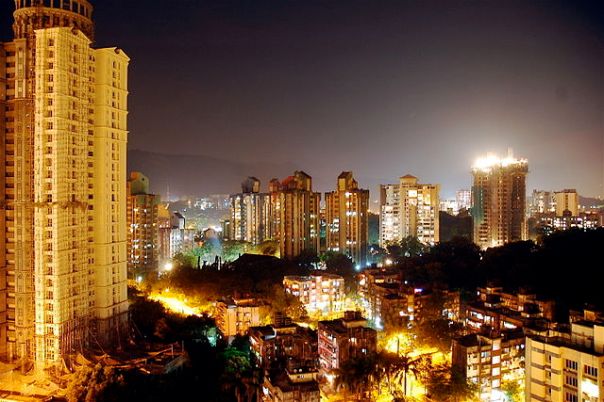
The City That Never Sleeps
If you are a native or current resident of Bombay, you probably have much to add to this list. I know I have missed other standout features of Mumbai like the beaches, Marine Drive, the ports, the location, the financial district, the diamond district, the crazy infrastructure (pot-holes and all), its resilience, people’s industriousness, the Dabbawalas, its cosmopolitan and secular nature and more. Well, I guess that means that this post is just going to have to get a Part Deux someday…
Now, if it’s been awhile since your last visit to the city, or if you have never had the pleasure (and sometimes pain) of a stay here, I hope this has intrigued you enough to give it a try. I promise you won’t be bored.
:
:
Photo Attribution:
Flower Seller: By Meena Kadri
Monsoon: By PlaneMad
Carting Bricks: By Greg O’Beirne
Bombay at Night: By Premshree Pillai

 The Yin and Yang of Life Anywhere